
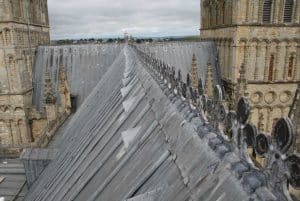
 Just like all artists, we have our preferred “paints and brushes” so to speak and reach for our favorites time and again. We don’t ever grab the lead coated copper, but it certainly has its place in the architectural metals world from an historic standpoint. This isn’t a metaphorical “brush” we’ll recommend for contemporary use, but we get asked a lot about it, so here’s our take:
Historical Applications of Lead Coated Copper
Lead, or lead coated copper in contemporary work, is most frequently used for historical applications, though not exclusively so. We get the name derivative for the symbol for lead on the periodic table “Pb” from the Latin “plumbum” from which our word for plumbing originated. And why is that?
In 100 BC, about the time of Julius Caesar, Romans were developing a revolutionary plumbing system. The technology and skills extrapolated from this new development of sheet metal work found their way to varied applications from food storage to the metal roof we recognize today. Romans found that metal, correctly installed, would keep roofs leak proof for hundreds of years; hence maintenance was also kept to a minimum. No longer did workers need to scale the treacherous heights of the buildings as with past frequency. The popularity of metal roofing spread like wildfire throughout Europe.
Due to the advent of the new metal roof technology, architects now had the freedom to design more expansive, taller, ornate and complex structures. Towers soaring to 600 feet started making regular appearances. (Can you imagine getting to the top of a cathedral without a crane or boom lift?) These people needed a way to keep workers safe, the building protected and maintenance to an absolute minimum. Metal roofs served that purpose.
The Legacy of Plumbing in Metal Roofing
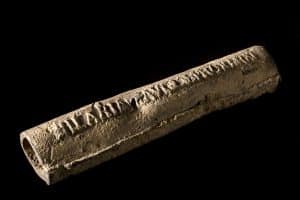
A real lead plumbing pipe from Roman times!
So essentially, plumbers were a precursor to our trade of metal roofing and cladding. It’s a long and storied one, thousands of years old and it all started because of lead.
Why lead and not some other material? Because the stuff was so darn malleable and easy to work with. Imagine back in the days where they had no power tools or machinery or mill to roll out sheets to perfect thickness tolerances. And now imagine having to form the metal around chimneys and steeples and other roof penetrations and ornaments. Today a lot of workers like to work in lead because it can be easily manipulated with simple hand tools.
Lead is also easily solderable which adds to workability.
You can see that from the time of chariots through the heyday of architecture’s golden years from the Middle Ages to the Romantic Period to American Colonial architecture to now, lead has definitely placed its stamp on architectural history.
Understanding Metal Reactivity and Longevity
 Veering off topic momentarily. Stay with us… Not all metals last forever. Zinc is used most famously for prolonging the life of steel through its sacrificial properties. Magnesium and zinc are often used as sacrificial metals. They are more reactive than iron and lose their electrons in preference to iron. In very simple language, what that means is, zinc will react with water and other pollutants over time creating a solvent that washes away, which makes the material thinner and weaker over time. See this phenomenon demonstrated here in the before and after pictures of a restored zinc ornament.
But lest we disparage zinc, which is one of our favorite metals of all time, bear in mind, correctly installed, it can last permanently and maintenance-free for a century. We used that example to illustrate how much more stable it is than steel which is why they make galvanized material…the budget of steel with a prolonged lifespan that zinc offers.
 We had to veer off topic a bit to talk about another reason lead has been popular throughout the ages: longevity. The last thing an old-timey, power tool bereft metal roof master would want would be to constantly scale that castle tower fixing stuff that broke just because of environment and the passage of time. Let’s face it. Lead lasts.
Comparing Metal Reactivity
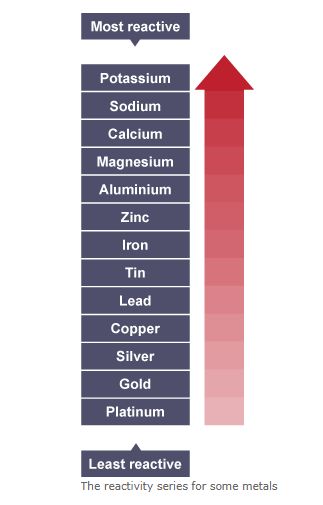
Remember how we were talking about reactivity? Here is an abbreviated list of commonly used metals and their propensity to react.
Lead is pretty low on the list, even surpassing tin! And we love tin!
Getting off the subject yet again, but just because it’s interesting: although tin is used to coat steel cans, it does not act as a sacrificial metal. Instead, it acts only as a barrier to stop air and water reaching the surface of the iron or steel. The tin layer may actually make rusting happen faster if it gets scratched, because then iron loses electrons in preference to tin.
Which is why our terne stainless is AWESOME! Best of all worlds. Check it out here: https://spenglerindustries.com/products/terne/
Ok, back on track: Another selling feature so to speak is that lead is also not particularly reactive with other traditional building metals and can therefore be more readily combined with other components and features of the building envelope. Refer to our dissimilar metals page for a primer on galvanic reaction:
https://spenglerindustries.com/news/galvanic-reaction/
The Risks of Using Lead
It is our assessment, for a number of reasons, to recommend the terne stainless or zinc we touted above in favor of lead. The risks of using lead are wide and deep. We’ve known for decades that lead is known to cause neurologic damage and all manner of health issues. It poses risks to the environment and causes all kinds of problems we don’t have time to discuss here. We appreciate why lead was used for so long, but when we know better, we do better. Let’s all strive for high-level building standards and plan with safe materials.
If you require a historic re-roof or a new build with a sanctioned, historic material, we are here for you and will help you figure out a suitable alternative to lead. You can trust us as world leaders in historic restoration. Give us a call today!
Further reading:
Lead Exposure and Health Risks:https://www.cdc.gov/niosh/topics/lead/
History of Lead in Plumbing:https://www.history.com/topics/inventions/plumbing
